Many organisations still rely on internal teams to print, fold, and post routine business mail by hand. It often starts as a simple, manageable task. Over time, as volumes increase and deadlines tighten, it takes up more time and creates pressure across the workflow.
Hybrid mailing solutions offer a more efficient way to manage that process. By moving from manual handling to digital submission and managed fulfilment, organisations can reduce admin and support a more consistent mailing process.
EasyPost Hybrid Mail helps organisations simplify mailing through a managed process. That means less internal handling, better operational control, and a more dependable way to keep important communications moving.
A manual mailing process often works well at low volumes. The challenge tends to appear gradually. Documents need printing, checking, folding, inserting, and preparing for post. Each step on its own feels manageable, but together they start to take up more of the working day.
The impact is not just the time spent completing the task. It is where that time comes from. Finance, operations, and admin teams are often pulled away from higher-value work to keep mail moving.
This becomes more noticeable when approvals are required, teams are working across multiple locations, or deadlines fall later in the day. A routine process can start to slow the wider workflow.
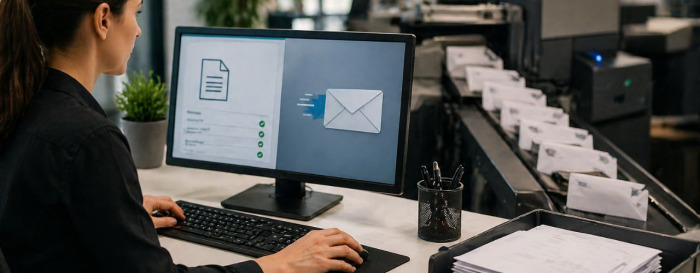
Hybrid mailing solutions change how that process is handled. Instead of printing and posting documents in-house, your team submits files digitally. From there, printing, enclosing, and dispatch are handled through a managed fulfilment process.
The difference is practical. Your team no longer needs to coordinate each stage of the mailing process internally.
Time spent printing packs, folding documents, managing stationery, and working around collection times is reduced. Those tasks still happen, but they are no longer your team’s responsibility. That allows staff to stay focused on their roles while outbound mail continues in the background.
Once the physical handling is removed, teams can manage outbound mail in a more controlled way. Instead of working around print runs and collection times, documents can be prepared and released more predictably. It also becomes easier to coordinate across departments, so finance, operations, and customer-facing teams are not all trying to manage the same process at once.
With CDP’s EasyPost Hybrid Mail, documents are submitted digitally and processed against a clear daily cut-off, with the option to hold items before release. This gives teams a more predictable way to manage deadlines and plan around outgoing communications.
It also gives teams better visibility over what is being dispatched. That clarity helps reduce uncertainty and keeps different departments aligned.
Manual handling naturally creates more opportunities for mistakes. In busy periods, small checks can be rushed or skipped, and issues are often only spotted after documents have already been sent. That can lead to reprints, follow-up communication, and additional admin that could have been avoided with a more controlled process. Documents can be printed incorrectly, pages can be collated out of order, or items can be delayed.
A managed workflow reduces the reliance on repetitive manual steps. That can help support a more consistent output, particularly for communications that are sent regularly or need to go out on time.
The benefits are most noticeable with repeat outbound communications.
Invoices, statements, customer letters, notices, appointment confirmations, and other forms of transactional mail all follow a similar pattern. They need to be sent accurately and on time, often in steady volumes.
When these types of documents are handled manually, the process tends to grow alongside the business. Moving them into a managed workflow creates a more stable way to handle that growth.
For many organisations, the need for change becomes clear over time rather than all at once.
A useful way to look at it is by tracking how much of the working day is spent on tasks around mailing rather than on the work the documents support. When preparation, checking, and release start to interrupt other priorities, the process is no longer just administrative. It becomes operational. At that point, even small inefficiencies can compound across the week, making deadlines tighter and increasing reliance on workarounds.
Teams may find themselves spending part of each day preparing post. Deadlines may start to create pressure later in the working day. Volumes increase, but the process stays the same. Different sites or departments begin to handle mail in different ways.
At that point, the process is no longer supporting the way the business operates. A structured print audit can help identify where time and effort are being lost. If that sounds familiar, it may be time to look at where your mailing process is creating unnecessary admin. Speak to our team about your current set-up.
We take the pressure out of outbound mail by handling the print and fulfilment stages through a managed process.
With EasyPost Hybrid Mail, documents are submitted digitally while we manage printing, enclosing, and dispatch. That removes the need for internal teams to coordinate each stage of the process while still retaining control over how and when communications are sent.
This approach reflects how we work across all services. We focus on making processes easier to manage, reducing unnecessary admin, and helping organisations keep their operations running smoothly.
Manual mailing often stays in place because it feels familiar. Over time, that familiarity can start to create more pressure than it saves.
Hybrid mailing solutions provide a more straightforward way to manage outbound post. They reduce manual effort and support a more consistent process across routine communications.
We help organisations move to a more dependable workflow that removes admin pressure and keeps communication moving. If you want a more dependable way to manage outbound mail, get in touch with our team and we can talk through what a more managed process could look like.
Most hybrid mailing solutions are designed to work alongside existing systems rather than replace them. Documents can usually be uploaded directly, printed from a desktop, or exported from finance, CRM, or operational systems. This allows teams to keep their current workflows while removing the manual handling stages that sit after document creation.
A digital mailroom typically refers to how inbound mail is received and managed electronically. Hybrid mail focuses on outbound communications, where documents are sent digitally and physically delivered after automated print and fulfilment. Many organisations use both as part of a wider communication process.
Key considerations include how documents are submitted, how fulfilment is handled, visibility of what is being sent, cut-off times for processing, and how well the service fits into your existing workflow. The goal is to reduce internal effort while maintaining control over communications.

74-82 Rose Lane,
Liverpool,
L18 8EE

Tel: 0151 724 7000
Fax: 0151 724 6478
Unit 1,
Tomo Industrial Estate,
Packet Boat Lane,
Cowley,
Uxbridge,
UB8 2JP
Tel: 01895 462462
Fax: 01895 420911