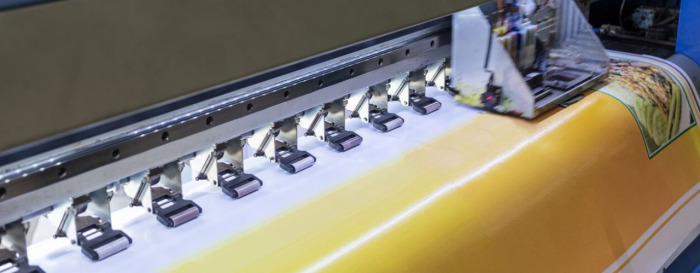
If you manage signage, displays, or branded environments in busy physical spaces, you already know that large format printing must earn attention quickly. This has communicated clearly in environments where people are moving quickly and deciding fast. Poor placement, weak contrast, unsuitable materials, and inconsistent rollout can reduce impact and create extra pressure for your team. In practice, large format printing usually performs best when those details are resolved early rather than late in the process. Good planning helps the finished display work in the setting it was made for.
A large display does not earn attention just because it is big. In busy environments, people glance, keep moving, and decide quickly whether something is relevant. If the message is hard to read, the hierarchy is weak, or the display sits outside the natural sightline, the opportunity is usually lost.
The strongest display work is clear first. It attracts attention, communicates the point quickly, and supports a clear next step. Complex layouts slow understanding. Clear ones help the message land faster. That is where the commercial value lies for businesses trying to improve visibility in physical spaces.
Many large format projects underperform for reasons that can be addressed early. The issue is rarely that the print is simply too small or too plain. More often, the problem is that the message and environment have not been considered properly from the start.
Some of the most common mistakes include:
These mistakes have practical consequences. The message becomes harder to absorb, the display loses impact, and teams face reprints, redesigns, or weak campaign performance that better planning could have avoided.
This matters even more when a wide-format campaign is rolled out across multiple locations. Small design decisions can become expensive when they are repeated at scale. That is why experienced guidance early in the process can save both time and budget later.
If you are planning a large format printing project and want to avoid unnecessary rework, inconsistent rollout, or late-stage pressure, contact CDP for practical advice on getting the details right before production begins. Early conversations can help resolve specification, materials, and installation questions before they start affecting budget, timescales, or consistency across the finished job.
Scale, colour, and material choice all shape how graphic display systems perform in the real world.
Scale must match the environment. A graphic viewed from a distance has different demands from one seen close in a reception area or exhibition stand. If it is too small, the message disappears. If it is too large, the design can feel clumsy or harder to navigate. The right scale depends on where the graphic sits, how people approach it, and how long they are likely to look at it.
Colour affects both attention and legibility. Strong brand colours can support recognition, but they still need to work practically. If colour choices reduce contrast or make text difficult to read, the display loses value. Consistency also matters, as visible shifts in colour across sites or formats can weaken brand quality.
Material choice influences durability, finish, and perception. Indoor graphics, outdoor signage, window displays, exhibition panels, wall coverings, and wayfinding systems all place different demands on print materials. Some environments require weather resistance, while others need a refined finish or short-term flexibility.
These printed environments are more than a creative decision. The right material can improve lifespan, maintain quality, and reduce replacement costs. The wrong choice can shorten the life of the project, create installation issues, or weaken the overall result.
A design can work well in one location and still fail in a wider rollout. Different surfaces, measurements, lighting conditions, access constraints, and timings all affect the result. Without tight control, one site can look polished while another appears inconsistent or poorly finished.
That is why large format printing projects need more than artwork supply. They need a dependable process behind specification, production, and fitting. In practice, that often means checking surfaces early, confirming measurements properly, and making sure the chosen finish suits the environment rather than relying on what looked strongest at approval stage. Small quality issues become more obvious at scale, and installation problems can undermine even strong creativity if they are left too late.
Project delivery should be treated as part of the value of display print production. When production, materials, and installation are aligned early, projects are easier to control and internal pressure stays lower.
Improving visual display output does not have to add complexity. Start by defining what the viewer needs to notice first, then match the message to the environment and viewing distance. Choose materials for the surface, lifespan, and finish required, and treat production and installation as part of one joined-up job rather than separate steps.
If you are planning a large format project and want to avoid unnecessary rework, inconsistent rollout, or late-stage pressure, practical advice on getting the details right before production begins can help you avoid problems later.
We know that wide-format display work is rarely only about output. Tight deadlines, multiple stakeholders, and complex environments all add pressure. Our role is to reduce that pressure through a clear process and a reliable outcome.
From design support and production planning to installation and wider project coordination, we help businesses and organisations deliver printed display projects that are seen, understood, and finished properly. The aim is clear. Better visibility. Stronger consistency. Less stress for your team.
If you are planning signage, displays, or a wider rollout and want a team that can help you manage production, materials, and installation with less pressure internally, get in touch with our team. We are always happy to talk through the practical side and help you shape the project properly from the start.
Large format printing is used for bigger visual applications such as signage, exhibition graphics, window displays, wall graphics, and branded panels. Standard digital printing is usually better suited to smaller-format items such as leaflets, brochures, booklets, posters, and day-to-day business print.
Consistency across multiple locations usually comes from tighter control over artwork versions, colour management, material specification, measurements, and installation standards. Using the same design file alone is often not enough.
The earlier you plan, the easier it is to control the outcome. Time is often needed for artwork checks, material selection, site surveys, print production, finishing, delivery, and installation, especially if the job covers several locations or custom sizing.

74-82 Rose Lane,
Liverpool,
L18 8EE

Tel: 0151 724 7000
Fax: 0151 724 6478
Unit 1,
Tomo Industrial Estate,
Packet Boat Lane,
Cowley,
Uxbridge,
UB8 2JP
Tel: 01895 462462
Fax: 01895 420911